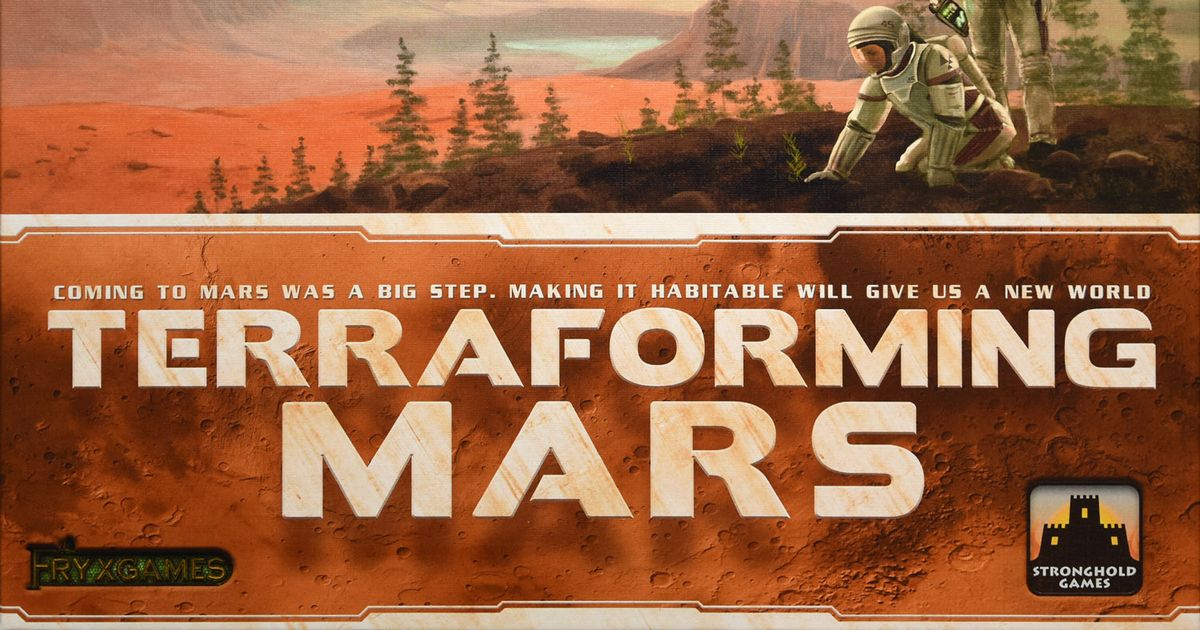
I’d played this a handful of times before but sat down with it again right after finishing Red Mars, and it’s a funny thing to experience a card-driven engine-builder immediately after six hundred pages about how genuinely brutal and slow terraforming would actually be, because Terraforming Mars compresses decades of atmospheric engineering into a few generations of card plays and it made me appreciate the abstraction more than resent it, this is clearly a game, not a simulation, and it’s honest about that trade.
The engine-building itself holds up. Corporations give you an asymmetric starting identity, and the card pool is deep enough that two games rarely play the same way, one run I’m chasing plant production and greenery placement, the next I’m all-in on space cards launching asteroids at the temperature track. The three global parameters, oxygen, temperature, ocean tiles, climbing on a shared timeline everyone’s contributing to and racing to benefit from, is a genuinely elegant shared-clock mechanism I haven’t seen done better elsewhere.
Two player works, but it’s noticeably slower to get the parameters moving with fewer engines running simultaneously, which surprised me the first time, I expected two-player to be the tight version and instead it’s the patient version. Downtime at higher counts is real too, especially once players have big hands and start doing math on chained card combos before playing. It’s not as viscerally exciting as Arcs or as brain-melting as Mage Knight, but it’s the game I reach for when I want something meaty that still respects a weeknight. Four stars, a very reliable four.