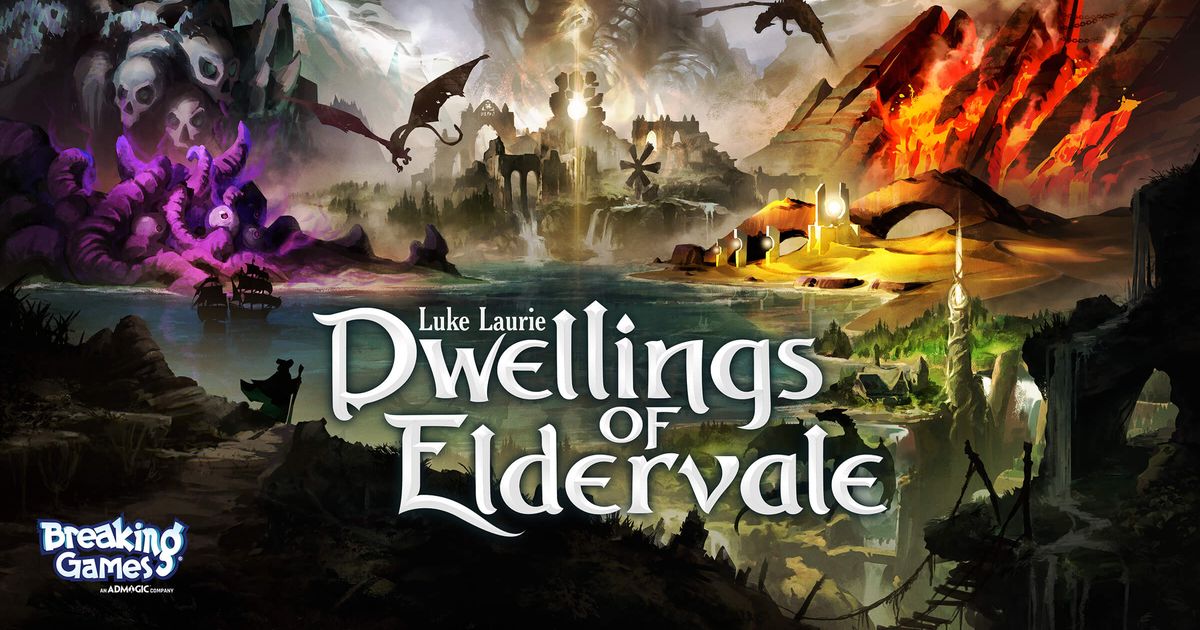
Bought this almost entirely off the box art, the cursed-tentacle-thing rising out of the water next to the volcanic ridge, and was fully prepared for the game underneath to be a letdown the way pretty games sometimes are. It wasn’t. Eldervale layers dwelling construction, dungeon crawling, monster hunting and market trading onto one shared board, and the actual tension is that you can’t do all five well in one game, you have to commit early to a lane, maybe two, and watch other players quietly build an engine in a lane you ignored. That’s my favorite kind of decision density, not “which move is best” but “which entire strategy am I even running.”
Two player specifically is where this shines for me, and I know that’s a niche thing to care about but I care about it a lot, most worker placement games get soft and slow at two because there’s nobody actually fighting you for spaces. Eldervale doesn’t have that problem, the board’s tight enough and the scoring paths competitive enough that two-player still has real bite, you’re racing for dwelling tiles and monster kills the whole way through, not just optimizing in a vacuum next to someone doing the same.
Downtime is the one real knock. Turns aren’t long individually but the number of interlocking systems means new players especially will stall out mid-turn doing math, and a four-player game can drag past the two hour mark even once everyone knows the rules, longer the first time through. It also reminds me a lot of Tapestry in silhouette, several scoring engines running in parallel on one board, though Eldervale’s combat and exploration give it a rawer, more adventure-game texture that Tapestry never really goes for. Four stars, would’ve been a five if the downtime at higher counts wasn’t a real cost.