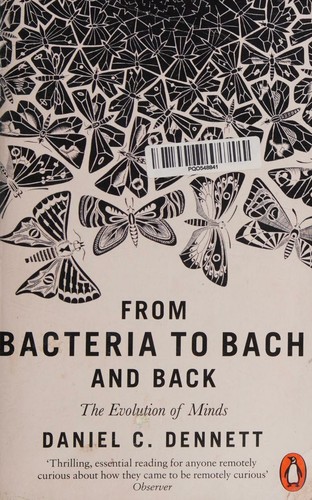
Dennett spends four hundred some pages arguing against what he calls “skyhooks,” explanations that sneak in a mind or a designer to do work that should be done by slow, grinding, undirected process, cranes all the way down instead. It’s the same move he’s been making his whole career, but here he applies it specifically to where thinking itself comes from, and the through-line from bacteria sensing chemical gradients up to a human composing a fugue is genuinely the most convincing version of that argument I’ve read, not because any single step is shocking but because he refuses to let you get off the hook at any point and say “okay but surely here is where the magic starts.”
The comprehension-without-comprehension bit is the part I keep bringing up at parties, badly, to people who did not ask. A thermostat “knows” the room is cold in some thin sense, competent without comprehending, and Dennett’s claim is that most of what your brain does, most of what a bee’s brain does, is exactly that kind of unconscious competence, and the weird, late, expensive add-on is the small sliver we actually experience as thought. Reading it back to back with a run of harder anthropology stuff, that thesis kept rhyming with what I already had rattling around from Henrich, culture doing cognitive work that individual brains take credit for.
Fair warning, the guy cannot resist a jab at people he disagrees with, there’s a recurring needle at certain philosophers that reads a little score-settly by book four of the digression, and the meme-as-cultural-replicator stuff felt dated compared to how carefully everything else was argued. Still landed as a four though, not a five, mostly because I finished it wanting the tighter two-hundred-page version that’s obviously buried inside it.